
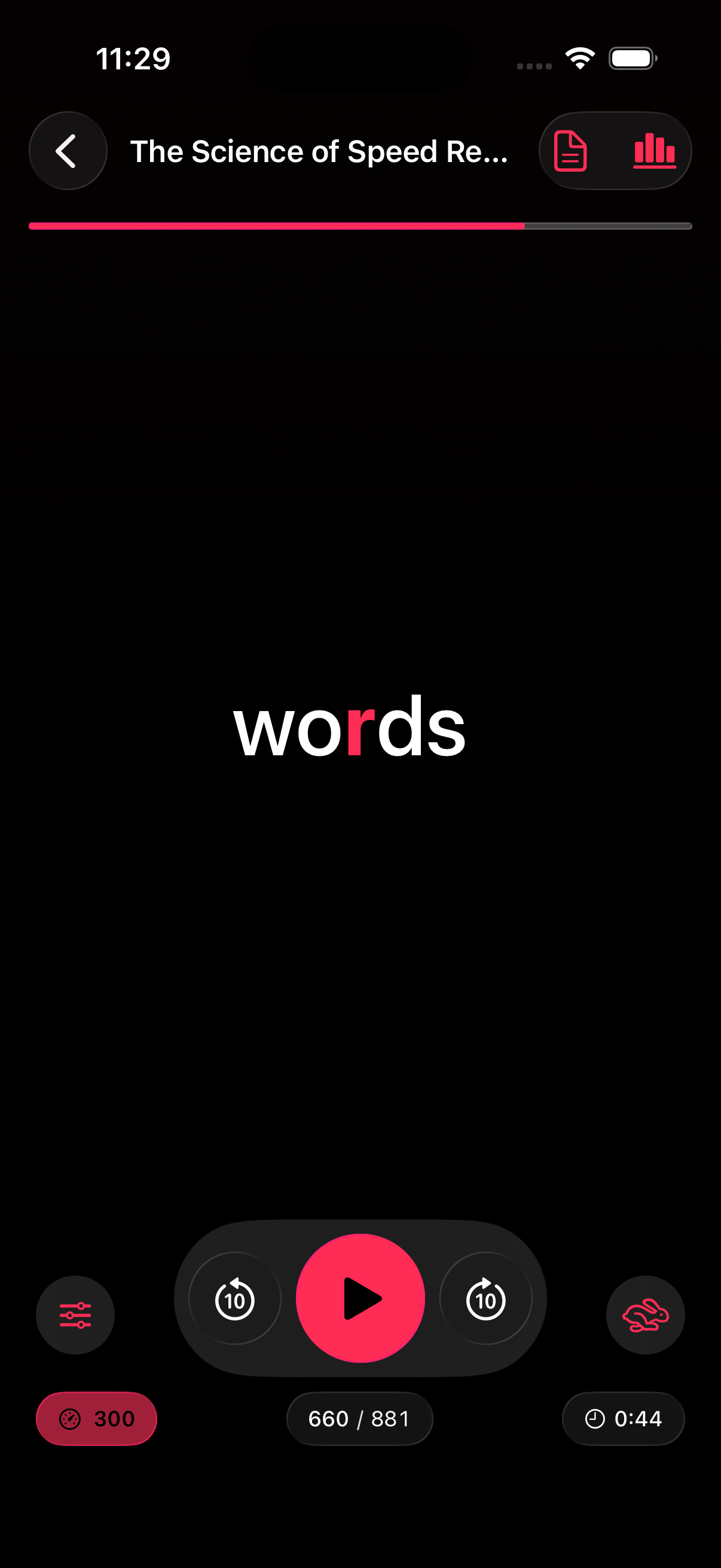
ORP highlighting is a visual cue that tries to place your eye closer to the part of a word where recognition happens fastest. The phrase ORP stands for optimal recognition point. In plain terms, ORP highlighting means one part of each word gets visual emphasis so the eye has a steadier place to land. If you have ever opened a paced reading app and felt that the words were moving fast but your eye still had to “search” inside each word, ORP highlighting is trying to reduce that work.
What ORP highlighting is trying to solve
ORP highlighting comes from a very simple problem. Fast reading is not only about how quickly words appear. It is also about how quickly your eye knows where to look. In normal reading, the eye makes quick jumps and short fixations across a line of text. Research on eye movements and RSVP reading keeps coming back to the same tension: readers want pace, but they also need stable recognition and enough comprehension to keep the text meaningful.
That is where ORP highlighting enters the picture. It gives the eye a stronger visual center. The goal is not magic. The goal is to reduce hesitation. A steadier landing point can make paced reading feel calmer, especially when words are appearing one by one or when the display is using strong visual timing.
Apple’s accessibility and reading settings pages do not talk about ORP by name, but they do reinforce the wider idea that readability changes with presentation. Apple Support shows users how to change font size, adjust display and text size, and tune spoken content speed. ORP highlighting belongs in that same family of readable presentation choices.
ORP highlighting and RSVP are related, but not identical
People often lump ORP highlighting together with RSVP reading, but they are not the same thing. RSVP describes a reading method where words appear in sequence, often one at a time, at a set pace. ORP highlighting is one way to style those words so they are easier to pick up. You can think of RSVP as the timing system and ORP highlighting as a visual support inside that timing system.
Here is why that distinction matters. A reader may like paced word-by-word reading but dislike strong ORP emphasis. Another reader may feel the opposite and need the extra cue to stay centered. That is why ORP highlighting belongs inside reader customization and reading modes, not as a one-true-way claim.
Why some readers like ORP highlighting right away
ORP highlighting can feel useful within seconds for a few reasons.
First, it gives the eye a consistent place to land. Second, it can reduce the “floating” feeling some people get in fast single-word displays. Third, it often makes the text feel more structured even when the pace is high. That does not mean it works for everyone. It means the upside is easy to feel when it matches a reader’s habits.
This is also why ORP highlighting shows up in comparison searches. Readers who have seen Bionic Reading or other emphasis-based systems want to know whether the app uses bolding, mid-word emphasis, or some other visual cue. The right page should answer that with plain language and then point to RSVP Reader vs Bionic Reading.
Why some readers turn ORP highlighting down or off
ORP highlighting is not always the best fit. Some readers find heavy emphasis too loud. Others want a calmer page with less contrast and fewer visual instructions. Dense material can also change the answer. A word-level cue that feels helpful in a short article may start to feel distracting in a technical PDF or a long book chapter.
That is why ORP highlighting works best as a setting, not a doctrine. A reader should be able to test it, adjust it, and decide whether it helps on this text right now. If the cue feels like a guide, keep it. If it feels like someone tapping your shoulder on every word, change it or switch reading surfaces.
How ORP highlighting fits a paced reading workflow
Let’s break it down. ORP highlighting matters most when three things are already true.
One, the reading surface has a strong pace. Two, the reader wants help staying centered. Three, the text is still simple enough that pacing is useful. In that setting, ORP highlighting can make reading feel more stable because it gives the eye a repeated target.
It matters less when the reader wants full-page structure, deep review, or low-intervention visual reading. That is why ORP highlighting should sit alongside other options like full-text reading, theme choice, line spacing, and listen mode. It is one tool in the reading kit.
What ORP highlighting is not
ORP highlighting is not a guarantee of better comprehension. It is not a substitute for slowing down when the material gets difficult. It is not proof that faster is always better. Strong speed-reading claims often break down when comprehension gets measured carefully, and research reviews have pushed back on grand promises that people can read extremely fast with no tradeoff.
That does not make ORP highlighting useless. It makes it normal. It is a display choice that may help some readers keep pace more comfortably. Used that way, it is useful. Marketed as a shortcut that erases every limit of reading, it becomes less believable.
The review article by Rayner and colleagues on speed reading is helpful here because it reminds readers that comprehension still matters and that very high speed claims often fail once the text gets challenging. That is a healthier frame for ORP highlighting too.
ORP highlighting versus Bionic-style emphasis
This is the comparison many readers care about first. ORP highlighting and Bionic Reading both change how words look to guide the eye, but they are not identical in feel or purpose.
Bionic Reading is a branded method built around emphasized letter groups inside words. Its official site describes the method as guiding the eyes through artificial fixation points. ORP highlighting in RSVP Reader should be described more modestly. It is a word-focus aid inside a paced reading workflow. That means the method sits closer to RSVP timing and session control than to a whole-page typographic layer.
Here is why that difference matters. If a reader mainly wants an emphasis treatment over normal paragraph reading, Bionic-style presentation may be the comparison they care about. If they want paced reading with adjustable speed, ORP highlighting is one part of a broader reading system.
How to test ORP highlighting in a useful way
If you want to know whether ORP highlighting helps you, test it with the same text in more than one setup.
Start with an easy article. Read a few paragraphs at a moderate pace with ORP highlighting on. Then read a comparable section with the emphasis reduced or changed. Pay attention to where your eye feels calm and where it feels like it is working too hard.
Next, try a denser piece of text. ORP highlighting may feel different once the sentence structure gets harder. Then try the same experiment at two different speeds. Sometimes people blame ORP highlighting when the real issue is that the pace is simply too high.
That kind of test is more useful than asking whether ORP highlighting is “good” in the abstract.
When ORP highlighting helps most
ORP highlighting tends to make the most sense in three situations.
It helps when the reader wants a stronger focal cue in a paced RSVP session. It helps when the person is trying to reduce search work inside each word. It helps when a little extra visual guidance feels calming rather than noisy.
It makes less sense when the reader already feels overloaded by bolding or high contrast, when the material depends on layout and structure, or when the task is close study rather than first-pass reading.
Next steps
If ORP highlighting sounds close to what you want, compare it inside reading modes. If you want to see how it differs from a branded emphasis method, read RSVP Reader vs Bionic Reading. If your bigger question is how paced reading works at all, go to how RSVP speed reading works. ORP highlighting works best when it is presented as a practical visual guide inside a broader reading system.
Sources
So Much to Read, So Little Time: How Do We Read, and Can Speed Reading Help? | Association for Psychological Science | January 2016 | https://journals.sagepub.com/doi/10.1177/1529100615623267 Changes across the psychometric function following perceptual learning of an RSVP reading task | PubMed | January 22, 2015 | https://pubmed.ncbi.nlm.nih.gov/25566119/ Bionic Reading | Bionic Reading | Publication date not listed | https://bionic-reading.com/ Change the font size on your iPhone, iPad, and iPod touch | Apple Support | August 22, 2023 | https://support.apple.com/en-us/102453